Kalamkari
Pre-1500s till Present
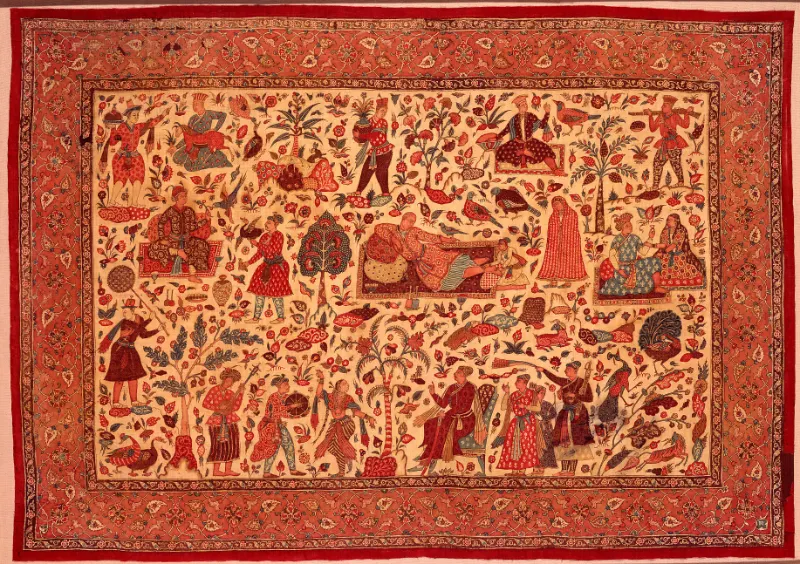
Kalamkari is one of those traditions that refuses to sit neatly in any single box, and that is exactly what makes it so rewarding to think about. It grew up in the Deccan under the Qutb Shahi rulers of Golconda, in a world where Persian courtly taste met local Telugu and Indian ways of seeing. Look at the great early rumals from around 1640 to 50, the ones now in the Met, and you can watch that meeting happen on the cloth itself: courtiers in Persian robes beside figures in Indian dress, every inch of the ground crowded with trees, animals, lovers exchanging glances, musicians, hunters. There is no empty space, no rest for the eye, and that density tells you these were made by people steeped in the same sensibility that produced Deccani court painting.
What makes kalamkari so compelling is how it quietly undoes the tidy line we like to draw between painting and craft. The Srikalahasti work is painting in every meaningful sense, done with a pen on cloth, pulling its stories from the epics and from the temple hangings that framed ritual. These were sacred objects with a job to do. The Machilipatnam side of the tradition went another way entirely and became part of one of the biggest stories in early modern trade. Those block-printed and dyed Coromandel cottons travelled by the shipload through the Dutch and English companies to Persia, Southeast Asia, and Europe, where they changed how people dressed and decorated their homes so thoroughly that England and France eventually tried to ban them. The palampore hanging on a European wall and the humble temple cloth in Andhra are cousins, born of the same skill.
There is also something moving in the small human traces these textiles carry. A few of the surviving rumals bear inventory notes scribbled by clerks in the storerooms of Amber Palace near Jaipur, one dated to the winter of 1673, sometimes with prices. Suddenly the object comes alive, handled and counted and valued by someone long gone. That is the kind of detail that makes textile history feel real rather than abstract.
For anyone studying it seriously, kalamkari asks hard and interesting questions. Most pieces are unsigned and were made in numbers, so attribution and dating are genuinely difficult, and telling one workshop from another takes real looking. But that difficulty is also the point: here is a single technique that could be a sacred image, a courtly luxury, and an export commodity all at once. Its later life is just as telling, from decline under colonial industry to revival through Kamaladevi Chattopadhyay and the wider handicrafts movement, and more recently its GI recognition, all of which keep pulling it into present-day arguments about craft, authenticity, and what we mean when we call something a tradition.